
The way most companies run win-loss analysis is broken and it's costing them pipeline they can't afford to lose.
Most go-to-market teams are sitting on fragmented signals, biased feedback, and CRM fields that tell half the story. This guide covers what a modern win-loss program looks like, the common pitfalls that hold teams back, and the best practices to build one that drives real revenue outcomes.
- What Is a Win-Loss Program?
A win-loss program is a structured, ongoing process to answer the questions that keep revenue leaders up at night:
- Why did a prospect choose us over the competition?
- Why did we lose and to whom?
- Why are customers churning after onboarding?
- Which accounts are showing early warning signs we should act on now?
When run programmatically not as a one-off post-mortem, a win-loss program becomes a strategic lever for your entire GTM motion. It aligns product, marketing, sales, and customer success around shared evidence, not opinions.
Done right, it doesn't just explain the past. It shapes what you do next.
2. The Problems with How Most GTM Teams Run Win-Loss Analysis Today
2.1 Over-Reliance on CRM Data and Sales Feedback
CRM fields are only as good as the person filling them in. In most organisations, that means incomplete, inconsistent, or outright inaccurate data because sales teams are optimising for closing deals, not data hygiene.
Even when CRM data is well-maintained, it's shallow. A dropdown field for "loss reason" can tell you what happened, but never why. And when you layer in sales feedback as your primary qualitative input, you introduce a structural bias: salespeople naturally interpret outcomes through their own lens, attributing wins to their relationship skills and losses to pricing or product gaps.
The result? Themes that feel directional but lack the confidence to act on.
2.2 Data Fragmentation Makes Signal Detection Nearly Impossible
Customers don't communicate through one channel. They leave signals in support tickets, product usage patterns, sales call recordings, Slack threads, NPS responses, renewal conversations, and competitive mentions.
Tracking all of these signals across the full customer lifecycle requires serious infrastructure. Most teams don't have it. So they cherry-pick the sources they can access easily — and miss the signals that matter most.
2.3 Manual Overload for PMM and Customer Success Teams
Running a continuous win-loss program manually is exhausting. Scheduling interviews, synthesising call transcripts, mapping themes, updating competitive battlecards, tracking churn signals — the operational burden falls disproportionately on PMM and CS teams who are already stretched thin.
The outcome? Win-loss becomes a quarterly report nobody reads, rather than a living intelligence layer that informs daily decisions.
2.4 Win-Loss Programs Stop at the Sale
Most traditional win-loss programs focus exclusively on pre-sale: why did we win or lose the deal? But the real revenue intelligence story extends well beyond the contract signature.
What happens at onboarding? How does product adoption evolve over the first 90 days? What triggers churn six months in? These post-sale signals are gold — and most programs never capture them.
3. Best Practices to Build a Modern Win-Loss Program
3.1 Connect Signals Across Multiple Sources
A single source will never give you a high-confidence signal. A strong win-loss program draws from:
- CRM data — for deal context, firmographics, and outcome tagging
- Sales call recordings — for verbatim buyer language and objection patterns
- Internal Slack conversations — for real-time deal commentary and rep sentiment
- Customer interviews — for qualitative depth on decision criteria
- Product usage data — for adoption signals and churn risk indicators
- Support tickets — for friction points post-sale
- Competitive intelligence feeds — for tracking what's changing in your market
- Your own market knowledge and experience — for sense check and human validation
No single source provides enough confidence on its own. The power comes from triangulation — finding the same signal across multiple independent data points.
3.2 Build for Cross-Source Inference
The goal isn't to collect more data. It's to connect it in a way that surfaces actionable patterns. The best win-loss programs are architected to draw inferences across sources automatically — spotting when a churn signal in support tickets aligns with a drop in product engagement and a competitor mention in a sales call.
Most teams neither have the internal capability to build this infrastructure nor the resources to sustain it. This is where purpose-built, AI-native win-loss platforms become the pragmatic choice over a bespoke data engineering project that takes quarters to deliver.
3.3 Go Beyond the Deal. Track the Full Customer Lifecycle
Your win-loss program should answer questions across the entire revenue journey:
- Pre-sale: Why are we winning and losing deals? Which competitive narratives are landing?
- Onboarding: Where is adoption stalling? Which customers are at early churn risk?
- Retention: Which accounts are showing upsell and cross-sell readiness? Which are going cold?
- Expansion: What are the triggers for expansion conversations and are your teams capturing them?
Thinking holistically across the customer lifecycle transforms win-loss from a retrospective exercise into a forward-looking revenue intelligence program.
3.4 Answer the Questions That Drive Business Decisions
A mature win-loss program should be able to answer, on demand:
- Which accounts are at risk of churning? With enough lead time to intervene.
- Which accounts are showing upsell or cross-sell signals? So sales can prioritise the right conversations.
- What emerging loss themes should we address now? Before they become systemic pipeline problems.
- Which recently launched competitor products are impacting our win rate? With enough specificity to update messaging, battlecards, and product roadmap.
If your current program can't answer these questions with data-backed confidence, it's not doing its job.
3.5 Use Tools That Remove the Manual Burden
The biggest barrier to a programmatic win-loss program isn't strategy — it's execution capacity. Teams underinvest because the operational overhead feels too high.
AI-native win-loss platforms like Signofy are designed to eliminate that barrier. Rather than spending weeks wiring together data sources, Signofy connects your CRM, call recordings, support data, and product signals out of the box — and starts surfacing win-loss-churn intelligence in hours, not months.
The goal is to get your team focused on acting on insights, not producing reports.
5. Key Takeaways
Building a win-loss program that actually moves the needle comes down to five principles:
- Think holistically across the customer lifecycle — pre-sale, onboarding, retention, and expansion
- Draw cross-source signals — use multiple data inputs and your own market knowledge to build high-confidence conclusions
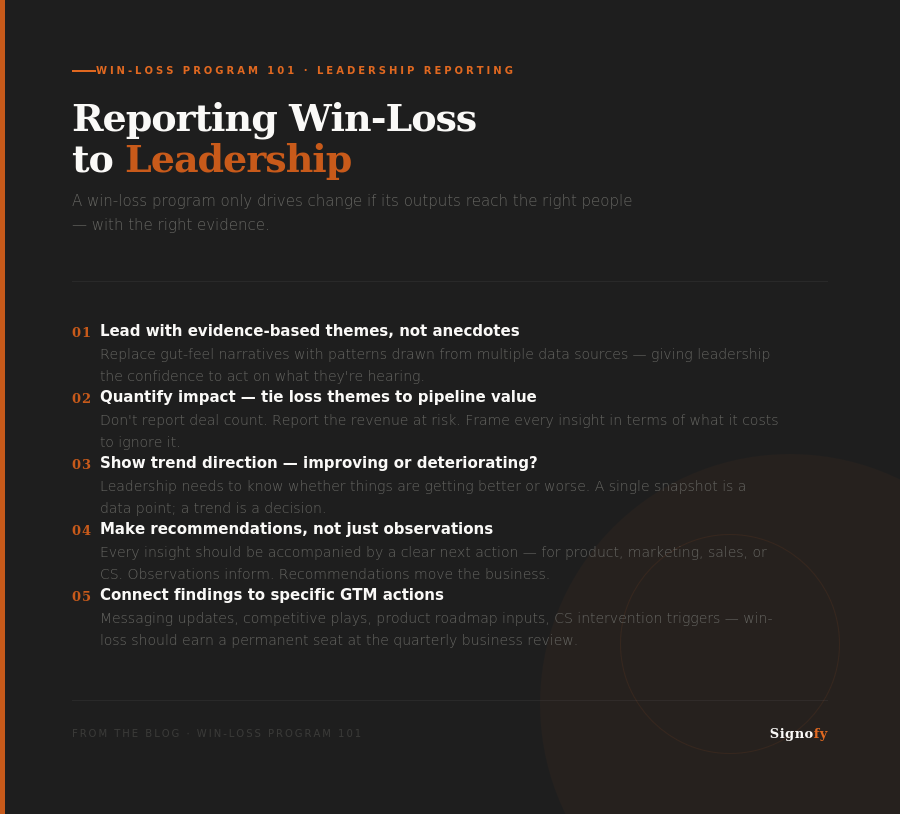
- Report with evidence — give leadership data-backed insights with clear recommendations
- Make it programmatic — a win-loss program you run quarterly is a report; one that runs continuously is a competitive advantage
- Remove manual overhead — use tools like Signofy to connect your data sources and focus your team on action, not administration
The GTM teams winning in 2026 aren't the ones with the most data. They're the ones that have built the intelligence layer to turn signals into decisions — fast