
Most GTM teams don't have an intelligence problem. They have a confidence problem.
The signals exist. Win/loss data lives in your CRM. Customer sentiment is buried in support tickets and call recordings. Competitive moves are happening in public view. Your own pipeline tells a story every single week.
And yet, when it comes time to make a revenue decision, the room goes quiet. Which signal do you act on? Whose data do you trust? Why did that enterprise account churn after the first contract term? Why does your sales team keep losing to the same competitor without anyone knowing exactly why?
That gap between having signals and being confident enough to act on them is exactly what GTM intelligence is designed to close.
1.What Is GTM Intelligence?
GTM intelligence is the practice of connecting signals across your entire customer lifecycle from first competitive touchpoint to post-sale churn risk into a unified, actionable view that drives better revenue decisions.
It's not a dashboard. It's not a CRM report. And it's not the same as revenue intelligence, sales intelligence, or conversation intelligence though it draws from all of them.
Think of it this way:
Sales intelligence tells you who to reach.
Conversation intelligence tells you how deals are progressing.
Revenue intelligence tells you what's happening in your pipeline.
GTM intelligence tells you where to play and why you're winning or losing when you get there
The distinction matters. GTM intelligence is cross-source by design. It doesn't just look inside your CRM. It pulls in external signals, competitor moves, market shifts, review site sentiment, content performance and connects them to internal reality: deal outcomes, churn patterns, rep behaviour, and customer health.
The result isn't more data. It's fewer, higher-confidence decisions.
2.Why GTM Teams Struggle to Act on the Signals They Already Have
Here's a scenario most GTM practitioners will recognise immediately.
You ask your sales team why you're losing to a competitor. They give you five different answers. Your PMM pulls a win/loss report from Salesforce. Your CS team has a completely different read from the renewal conversations they've been having. Your marketing team is running campaigns based on ICP assumptions that haven't been revisited in 18 months.
Everyone has data. Nobody has a shared view of what it means.
This isn't a people problem. It's a structural one. GTM teams today face several compounding challenges:
Signal fragmentation. Your intelligence is spread across CRM fields, call recordings, battlecards, review sites, competitor websites, and customer success notes. Each source tells part of the story. None of them tell the whole one.
Conflicting signals. When different sources say different things, the default response is paralysis. Without a framework for reconciling signals, teams default to gut feeling — which often means the loudest voice in the room wins.
Structured data blind spots. Most GTM intelligence has historically been built on structured data: CRM records, pipeline stages, closed/won fields. But the richest signals: the why behind a win, the early warning of a churn, the friction in a buying conversation live in unstructured data. Call transcripts. Support tickets. Review site text. Slack messages. Email threads. Over 80% of meaningful GTM signal sits in unstructured sources that most teams never systematically analyse.
Cross-functional silos. Sales, marketing, product marketing, CS, and support all generate intelligence. But they rarely share it. Each function builds its own view, and the seams between them are exactly where the most important signals get lost.
Speed of market change. Competitors move faster than battlecard update cycles. Customer expectations shift between renewal conversations. A positioning assumption that was accurate six months ago may actively hurt you today.
The net effect: GTM teams make decisions based on incomplete, lagging, siloed data, and they do it with less confidence than the situation demands.
3.How GTM Intelligence Changes the Equation
Solving the problem isn't about adding more tools or generating more reports. It's about building a fundamentally different approach to how your team connects signals to decisions.
3.1 Build Cross-Source Intelligence: Inside and Out
No single source is sufficient anymore. The pace at which markets, competitors, and customers move means that a view built on CRM data alone will always be a lagging view.
Cross-source intelligence means deliberately connecting:
Internal signals: Win/loss data, deal velocity, rep performance, churn indicators, renewal friction, customer health scores, support volume and sentiment. External signals: Competitor product changes, G2/Capterra review trends, hiring patterns, pricing moves, content strategy shifts, funding announcements
When you connect these two layers, you stop asking "what happened?" and start asking "why did it happen and where is it about to happen again?"
This is the move from reactive reporting to proactive intelligence.
3.2 Unlock the Intelligence Hidden in Unstructured Data
Structured data tells you what. Unstructured data tells you the why.
A closed/lost field in Salesforce tells you a deal didn't close. The call recording of that final conversation tells you the prospect mentioned a competitor feature your team couldn't counter, that the economic buyer had changed three weeks earlier, and that your champion had gone quiet for two weeks before the decision.
That's intelligence. And it lives in text, images, and conversation, not in database fields.
Teams that harness unstructured data at scale, combining it with structured sources into a unified intelligence layer, build a real competitive advantage. Not because the data wasn't available before, but because they're the first to systematically use it.
3.3 Focus on the Signals That Drive Revenue Outcomes
Not all signals are equal. GTM intelligence isn't about monitoring everything. It's about having clarity on the four signal categories that matter most:
Brand and competitive perception. How is your brand being perceived relative to competitors in the market right now? What are buyers saying in reviews, communities, and sales conversations that your messaging needs to address?
Win/loss and churn patterns. Why are you winning the deals you win? Why are you losing the ones you lose? Why did that enterprise customer churn after Year 1? The answers to these questions grounded in signal, not anecdote, are the foundation of a GTM motion that compounds over time.
Content and channel effectiveness. are your marketing channels aligned to what customers are asking for? Are you showing up where buyers are looking, with the message they need at that stage?
Early customer signals. What are your existing customers telling you about usage patterns, support interactions, expansion behaviour, and renewal conversations about churn risk or upsell readiness?
3.4 Make Fewer Decisions, With Higher Confidence
This is the counterintuitive principle at the heart of GTM intelligence: the goal isn't to surface more insights. It's to make fewer decisions but make them with strong signal backing and genuine confidence.
The teams that execute best aren't the ones running the most analysis. They're the ones who've built enough intelligence infrastructure to know which decisions matter, when to make them, and what evidence they need before they do.
GTM intelligence gives teams the confidence to act, not just the data to deliberate.
4. A Diagnostic Test: Does Your GTM Motion Have an Intelligence Problem?
Before investing in any intelligence infrastructure, answer these questions honestly:
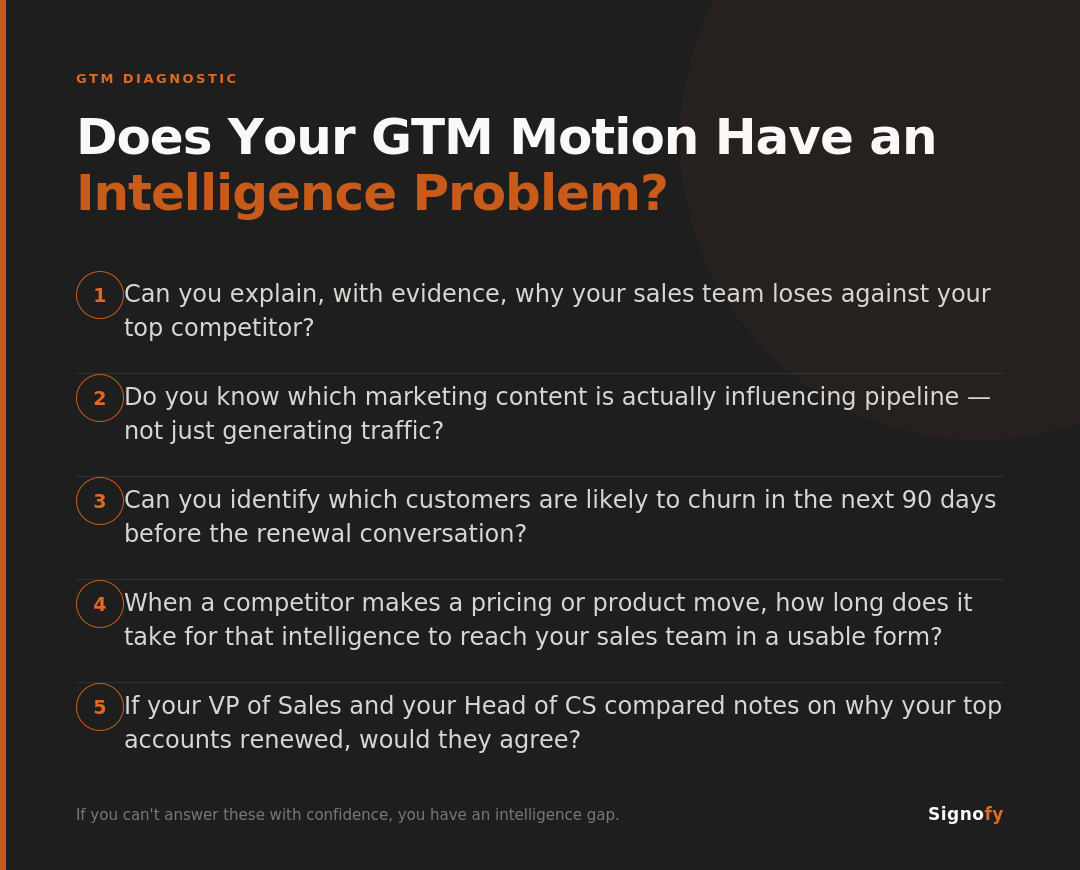
Can you explain, with evidence, why your sales team loses against your top competitor? Not a hunch, actual signal from deals, calls, and customer feedback. Do you know which marketing content is influencing pipelines, not just generating traffic? Can you identify which customers are likely to churn in the next 90 days before the renewal conversation? When a competitor makes a pricing or product move, how long does it take for that intelligence to reach your sales team in a usable form? If your VP of Sales and your Head of CS compared notes on why your top accounts renewed, would they agree?
If you can't answer these with confidence, your GTM motion has an intelligence gap. Not because you lack data but because the signals aren't connected into a view, your team can act on.
5. Key Takeaways
5.1 Understand the pitfalls first
If you can't answer why your sales team loses to a specific competitor, or why an enterprise account churned after the first contract term, that's not a CRM problem or a headcount problem. It's an intelligence problem and it compounds over time.
5.2 Build cross-source intelligence
Combine internal signals (CRM, win/loss, CS notes, call recordings) with external signals (competitive moves, review sentiment, market shifts) to build a view no single source can give you.
5.3 Unlock unstructured data
The most valuable GTM signals live in conversations, reviews, and text not database fields. Teams that systematically harness unstructured data alongside structured sources build a durable intelligence advantage.
5.4 Focus on four signal domains
Competitive perception, win/loss patterns, content effectiveness, and early customer signals. These are where the highest-value revenue decisions live.
5.5 Make fewer decisions with stronger conviction
The power of real GTM intelligence isn't that it generates more insights. It's that it gives your team the confidence to act on the right ones.
5.6 Accelerate with the right tools.
Tools like Signofy are built to operationalise GTM intelligence from day one, connecting competitive signals, win/loss analysis, content alignment, and deal outcomes into a cross-source intelligence layer so your team spends time driving decisions, not building reports.
GTM intelligence isn't a future capability. For the teams building it now, it's already the difference between reacting to the market and leading it.