
90% ofstartups fail not because of a bad product — but because of a bad go-to-marketstrategy. Here's the framework to fix that.
#Why Most GTM Strategies Fail Before They Start
You've built a great product. You know your ICP. You'vewritten the messaging. And then — nothing happens. Deals stall, pipeline driesup, and the team starts questioning everything except the one thing thatmatters most: the go-to-market motion.
The uncomfortable truth? Most GTM failures aren't productfailures. They're strategy failures — specifically, choosing the wrong motion,running too many at once, or confusing activity with direction.
This post breaks down the four core go-to-market strategies,when to use each one, what metrics to track, and the pitfalls that sink eventhe most promising launches. Whether you're a founder, a product marketer, or aGTM leader, this is the framework you actually need.
#What Is a Go-to-Market Strategy?
A go-to-market (GTM) strategy is the plan that defines whoyou're targeting, how you'll reach them, and how you'll convert them intopaying, loyal customers.
Think of it as the bridge between your product and yourmarket. It's not just a launch plan — it's the operating system for how yourrevenue engine runs.
A strong GTM strategy aligns every revenue-facing functionaround a single shared objective:
• Marketing — generating demand and awareness
• Sales — converting that demand into revenue
• Product — ensuring activation and retention
• Partnerships — extending reach through ecosystemchannels
• Customer Success — protecting and expanding existingrevenue
"GTMaligns Marketing · Sales · Product · Partnerships · Customer Success around oneshared goal."
Without that alignment, you get teams optimising for differentthings — and customers falling through the gaps.
The 5 Outcomes a GTM Team Owns
Before choosing a motion, understand what you're actuallyaccountable for:
• Revenue Growth — new customer acquisition and accountexpansion
• Market Penetration — increasing share in your targetsegments
• Customer Retention — reducing churn, increasing LTV
• Brand Awareness — ensuring the right buyers know youexist
• Pipeline Efficiency — converting marketing interestinto closed revenue
#The 4 GTM Strategies: An Overview
Not all go-to-market strategies are created equal. The rightmotion depends on your product complexity, buyer profile, ACV, and marketmaturity. Here are the four core options:
1. 🚀 Product-Led GTM
The product itself drives acquisition, expansion, andretention. Think Slack, Notion, Figma, Dropbox. Best for broad SaaS marketswhere low-friction onboarding and viral loops can do the heavy lifting.
2. 🤝 Direct Sales-Led GTM
The sales team drives acquisition — through both inbound andoutbound motions. Best for complex, high-ACV deals where relationships, demos,and consultative selling matter.
3. 🌐 Partner-Led GTM
Growth through partner ecosystems — channel resellers,marketplaces (AWS, Salesforce, HubSpot), and technology integrations. Best formarket expansion at scale with lower CAC.
4. 💡 Proposition-Led GTM
Same market. Same product. Radically better message. Thismotion is about sharpening your value proposition, repositioning your brand, orredesigning pricing. Best when you're in an existing market and need a newangle.
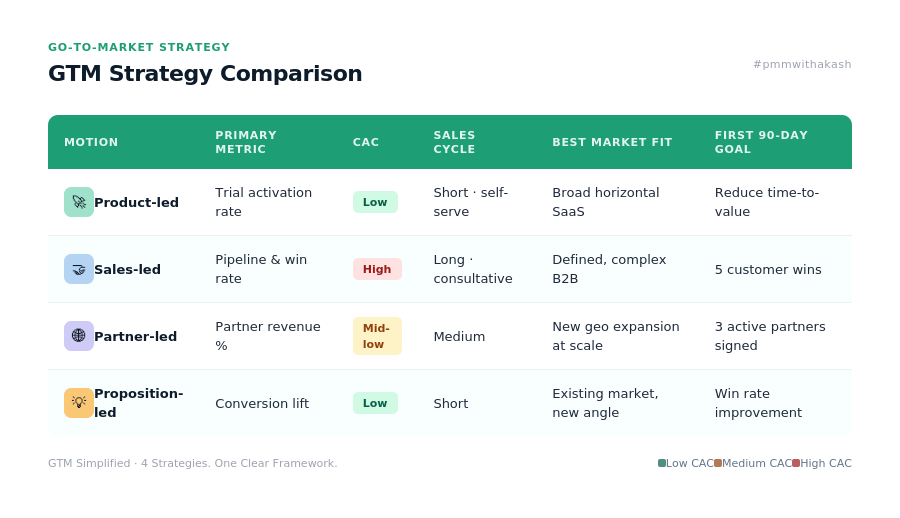
#GTM Strategy Comparison at a Glance
Use this table to quickly match your situation to the rightmotion:
#Deep Dive: Product-Led GTM
Product-led growth (PLG) is one of the most efficientgo-to-market motions when the conditions are right. The product issimultaneously the marketing channel, the sales motion, and the retentionengine.
The end-to-end PLG journey looks like this:
• Awareness → the product gets discovered through word ofmouth, SEO, or community
• Sign-Up / Trial → low-friction onboarding, no salescall required
• Activation → the user reaches their 'aha moment'quickly
• Adoption → usage expands within the product
• Conversion → free users convert to paid
• Upsell → product-qualified accounts (PQAs) expand intohigher tiers
• Retention → stickiness is built into the product itself
Key levers for PLG success: in-product nudges, usage-basedtriggers, viral loops, and product analytics to identify drop-off points.
PLG onlyworks when your product delivers standalone value quickly. If users needhand-holding to activate, PLG isn't your motion — yet.
#Deep Dive: Direct Sales-Led GTM
Sales-led GTM is the dominant motion in complex B2B — whereACV is high, buying committees are large, and decisions take months. Itrequires both inbound and outbound working together.
Inbound Motion
• Content marketing drives organic discovery
• SEO positions you where buyers are already searching
• Webinars and events attract warm, intent-rich leads
• Lead magnets capture buyer intent early
• MQLs flow directly to sales for follow-up
Outbound Motion
• Targeted account lists using ABM (account-basedmarketing)
• Cold outreach via email, phone, and LinkedIn
• Executive outreach for strategic accounts
• SDRs opening pipeline through prospecting
The financial rule of thumb in a sales-led model: LTV shouldbe at least 3× your Customer Acquisition Cost (CAC). If it's not, your uniteconomics will break before you scale.
Marketing's Role: Sales Enablement
In a sales-led model, marketing's job is to arm the sales team— not just generate leads. That means producing:
• Battle cards — competitive positioning and objectionhandling guides
• Case studies and ROI calculators — proof that yourproduct delivers
• Proposal templates and demo scripts — consistency atscale
• Segment messaging — tailored pitches for each buyerpersona
The #1failure in sales-led GTM: misalignment between what Marketing promises and whatSales delivers. Fix this first.
#Deep Dive: Partner-Led GTM
Partner-led GTM is the motion most teams underestimate — andthe one that can unlock the fastest path to scale once you have product-marketfit.
The Three Partner Types
• Channel Partners — resellers, distributors, VARs, andsystem integrators who sell your product within their own portfolio
• Marketplaces — AWS, Salesforce, and HubSpot app storeswhere buyers actively search for solutions
• Technology Partners — complementary vendors whointegrate with your product and co-sell to shared customers
Why Partner-Led GTM Works
• Market penetration at scale — partners already have therelationships
• Lower CAC — you're leveraging someone else's salesinfrastructure
• Trust transfer — buyers trust brands they already know
• Ecosystem lock-in — integrations create stickiness andswitching costs
The key to a successful partner programme? Make it easy tosell, make it profitable, make it supported, and make it recognised. Partnerexperience isn't a nice-to-have — it's the product.
#Deep Dive: Proposition-Led GTM
Proposition-led GTM is the motion that gets the leastattention — and arguably delivers the highest ROI when applied correctly. Thepremise is simple: same market, same product, radically better message.
This motion focuses on three levers:
• Product Messaging — speak buyer pain, not productfeatures. A messaging refresh can lift conversion without a single line of codebeing written.
• Brand Positioning — claim a distinct, ownable positionin the market. Define who you're for — and who you're not for.
• Pricing Strategy — good-better-best tiers, usage-basedmodels, and annual billing all shift conversion and expansion rates.
When Proposition-Led GTM Excels
• Growth has plateaued despite solid product-market fit
• Win rates are declining but the product is strong
• You're expanding into new buyer personas
• You have deep, existing customer insight to draw from
Where It Has Limits
• Cannot create demand in genuinely new markets
• Won't compensate for real product gaps
• Not suited to brand-new product launches
• Requires real customer insight — not assumptions
#The 4 GTM Pitfalls to Avoid
Most GTM launches fail the same four ways. Here's how to spotthem before they derail you:
01. Running 2+ GTM strategies at launch
Spreading resources across multiple motions guaranteesmediocrity in all of them. Pick one motion. Execute it fully. Layer in the nextwhen the first is working.
02. Using the same launch plan for every strategy
Each GTM motion needs different metrics, different activities,and different team roles. A PLG launch looks nothing like a sales-led launch.Build the plan to match the motion.
03. Treating launch day as the finish line
Launch day is the starting gun, not the trophy. Build a 90-daypost-launch plan before you ever go live — and treat the first quarter as alearning sprint.
04. Chasing the perfect launch
There is no perfect launch. There is only launch, learn, anditerate. The best GTM teams ship fast, measure everything, and compound theirlearnings month over month.
"Launchwith your best thinking. Learn fast. Iterate faster. Your second month shouldbe smarter than your first."
#How to Choose the Right GTM Motion
The right go-to-market strategy isn't theoretical — it'sdetermined by a handful of practical factors:
•Product complexity — does the user need hand-holding,or can they self-serve?
•ACV — high-ticket deals justify a sales team;low-ticket deals need automation
•Buyer profile — consumer-like buyers suit PLG;enterprise buyers need Sales-Led
•Market maturity — new categories need education;existing markets need positioning
•Competitive intensity — a crowded market may need aProposition-Led angle to break through
And the most honest diagnostic question: which ONE of thesefour motions are you actually running right now? If the answer is 'all of them,kind of' — that's your first problem to solve.
#The GTM Mindset: Sequential Excellence Beats Simultaneous Mediocrity
Great go-to-market strategies aren't built in a single launch.They're built through disciplined iteration — one motion, fully executed,compounding over time.
Sequential excellence beats simultaneous mediocrity — everytime.
Here's your action plan:
•Identify which ONE of the four GTM motions fits yourproduct and market
•Align your team's metrics, activities, and roles tothat motion
•Build a 90-day post-launch plan before you go live
•Launch, measure, and iterate — monthly
The best GTM teams aren't the ones with the most sophisticatedplaybooks. They're the ones who pick a direction, commit to it, and get smarterevery month.
#Key Takeaways
•A go-to-market strategy defines who you target, how youreach them, and how you convert them — it's not just a launch plan
•There are 4 GTM motions: Product-Led, Sales-Led,Partner-Led, and Proposition-Led
•Each motion requires different metrics, activities,team structures, and 90-day goals
•The biggest GTM pitfall is running multiple motionswithout fully committing to one
•Great GTM is built through iteration — launch, learn,and compound month over month
\